Part 2 of the series The 10 Commandments of AI in Business: Choosing the Right Intelligence for the Right Problem

Recap
In the introduction to this series, we made a single argument: that roughly 95% of enterprise generative-AI pilots fail (MIT, 2025) not because the technology is weak, but because of a failure of judgement — force-fitting the fashionable tool onto the wrong problem. AI literacy, we said, is knowing which intelligence to reach for, and when.
We laid out ten commandments to build that judgement. In one line each:
- The process is sovereign — start with the process, not the technology.
- Don’t invoke agents in vain — most problems don’t need one.
- Honour the humble LLM workflow — a single well-crafted call often wins.
- Honour predictive AI and automation — the proven elders solve most problems.
- Don’t slay your token budget — ground and retrieve before you build big.
- Be faithful to causation — correlation misleads when you’re deciding to act.
- Don’t steal the work that belongs to another tool — compose the right blend.
- Don’t let your agent bear false witness — autonomy demands accountability.
- Don’t covet only the frontier models — smaller, specialised models often fit better.
- Don’t covet your competitor’s AI — prove the cost-benefit in your context first.
If those ten are the map, this post is where we take the very first step — and it is the step every other commandment stands on. Because before you can decide whichAI to use, you have to understand the thing you’re actually trying to improve: your business process.
1.0 Introduction
Let us first replay a scene probably you have lived through
A problem is raised in a meeting :-
- Quotes are going out too slowly,
- Defects are slipping through,
- Campaigns are late.
Before anyone has looked at where the delay actually lives, someone says the sentence you now hear in every conference room:
“Why don’t we just put an AI agent on it?”
Heads nod. A pilot is funded. Six months later it joins the roughly 95% of enterprise generative-AI pilots that, per MIT’s 2025 study, delivered no measurable business impact.
The problem was never that the AI model was inadequate. It was never the prompt. It was never the framework. The mistake happened within the first few minutes of the meeting. The team asked, “Where can we apply AI?” when they should have asked, “Where does our business process actually need help?”
The rule is simple, you do not start with “Where can I use AI?” You start with “What is my process, where does it bleed, and what is the cheapest, most reliable thing – generative AI, predictive AI, automation, or a manual effort that stops the bleeding there?” That distinction is the foundation of this entire series. Everything else : the choice of LLM, predictive model, workflow, agent, or automation is secondary.
2.0 The business process is sovereign. Technology exists only to serve it.
Imagine three companies.
- Company A has access to the world’s most advanced AI models.
- Company B has average AI capability.
- Company C barely uses AI.
Which company wins? Most people instinctively choose Company A. The correct answer is:
The company with the best business process.
Technology amplifies process quality. It rarely compensates for poor process design. An AI agent cannot rescue a process that contains unnecessary approvals. An LLM cannot eliminate a policy bottleneck. Automation cannot compensate for poorly designed governance. Predictive AI cannot improve decisions if the wrong data is collected. A badly designed process simply becomes an expensive badly designed process. The first lesson every business leader must learn is therefore remarkably simple.
Never optimise technology before understanding the process it serves.
3.0 The Forgotten Science of Throughput
Long before Generative AI existed, operations researchers had already solved a surprisingly large part of this problem. In 1984, Eliyahu Goldratt introduced the Theory of Constraints in his influential book The Goal. The idea is almost deceptively simple.
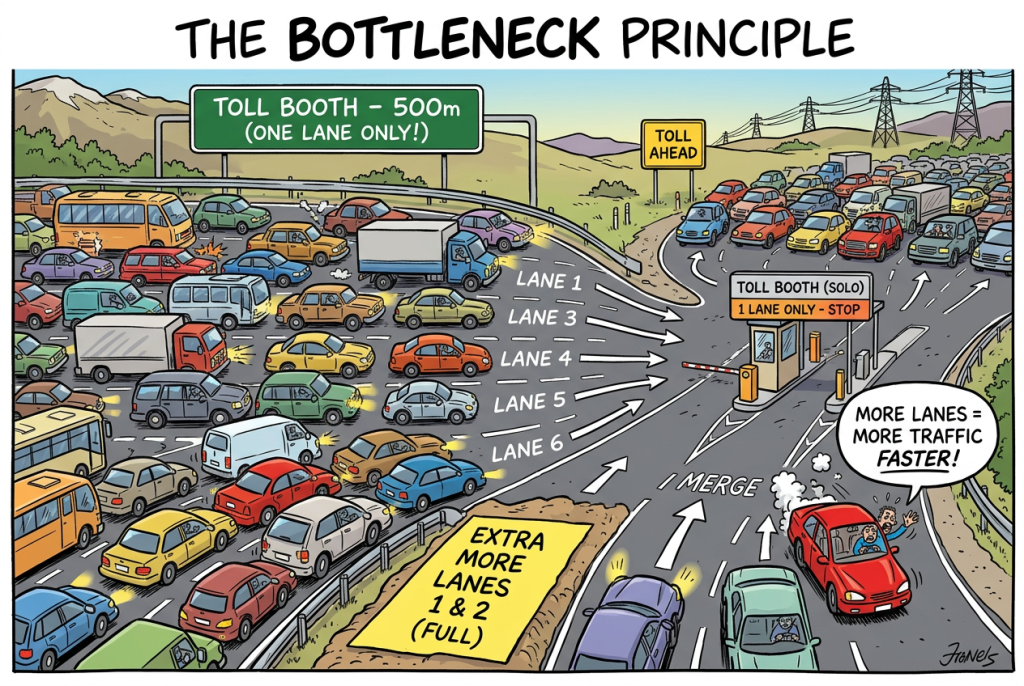
Every business process consists of a chain of activities. Like the strength of a chain being limited by its weakest link, the throughput of a process is determined by a single limiting step, the constraint. Improving anything other than that constraint rarely increases the output of the entire system.
Imagine a six-lane highway that narrows into a single toll booth. Would building two more lanes before the toll booth reduce congestion? Of course not. It simply allows more cars to reach the bottleneck faster.
Exactly the same mistake happens in AI projects. Organisations automate whatever is easiest to automate rather than what actually limits business throughput. The result is impressive demonstrations but disappointing business outcomes.
Goldratt’s five focusing steps:
- Identify the constraint.
- Exploit it – get everything you can out of it as-is.
- Subordinate everything else to it.
- Elevate it – invest to break the constraint.
- Repeat – the constraint will move; go find the new one.
Goldratt’s framework answers the where. The next challenge is answering the how.If the bottleneck has been identified, how should we remove it? Should we redesign the workflow? Introduce automation? Deploy predictive AI? Use Generative AI? Build an autonomous agent? Or simply hire another experienced employee?Before choosing any of these, we must first understand what the process is fundamentally trying to accomplish. Every process exists for one reason – to produce valuable business outcomes.
- A sales process exists to convert qualified opportunities.
- A manufacturing process exists to produce good units.
- A recruitment process exists to hire capable employees.
- A marketing process exists to launch campaigns.
Every AI investment should therefore answer one question.
How does this improve throughput?
If the answer is unclear, the AI project is probably solving the wrong problem. Of course, this immediately raises another question.
How do we systematically determine whether an AI intervention will improve throughput?
The following five-step discipline provides exactly that. It acts as a decision-making framework that helps identify where AI can genuinely create value, what type of intelligence is most appropriate, and just as importantly, where AI should not be applied at all.
4.0 The Five-Step Discipline Before You Think About AI

Before selecting any technology, every executive should perform five simple exercises.
Step 1 — Define the Business Outcome
Do not begin with technology. Define what valuable output the process exists to produce. Examples include:
- Good units manufactured
- Customer claims resolved
- Campaigns launched
- Orders fulfilled
- Policies approved
The metric must describe business value, not activity.
Step 2 — Map the Process
Break the process into its constituent steps.
- Where is time consumed?
- Where are decisions made?
- Where do errors occur?
- Where does work accumulate?
Without visibility into the process, AI becomes little more than educated guesswork.
Step 3 : Find the Constraint
Now measure – Not opinions, Not assumptions – Actual data.
- Where is work waiting?
- Where are queues forming?
- Where is the largest contributor to cycle time?
That is the only place worthy of serious attention.
Step 4 : Understand the Nature of the Constraint
This is where AI finally enters the discussion. Not all constraints require the same form of intelligence. Ask a simple question.
What kind of work is actually happening here?
| Nature of Work | Appropriate Intelligence |
| Generating content, language or creative ideas | Generative AI |
| Predicting future outcomes or classifying patterns | Predictive AI |
| Performing repetitive deterministic actions | Automation |
| Optimising allocation, routing or scheduling | Optimisation algorithms |
| Coordinating multiple systems | AI Agents |
| Exercising judgement, empathy or accountability | Human expertise |
Step 5 — Examine the Ripple Effects
Suppose AI removes today’s bottleneck.
- What becomes tomorrow’s bottleneck?
- Have you merely moved the queue downstream?
Every process redesign should consider second-order consequences. Business systems behave as systems, not isolated activities.
To illustrate how the framework supports technology investment decisions, we will evaluate three representative business processes. The metrics used throughout these examples are baseline assumptions designed to explain the core concepts. Because metrics are inherently organization-specific, enterprises must gather their own relevant data to execute this evaluation effectively.
4.1 Process Analysis 1 – Marketing: multi-channel campaign content production
Let us first take a process from the marketing industry.
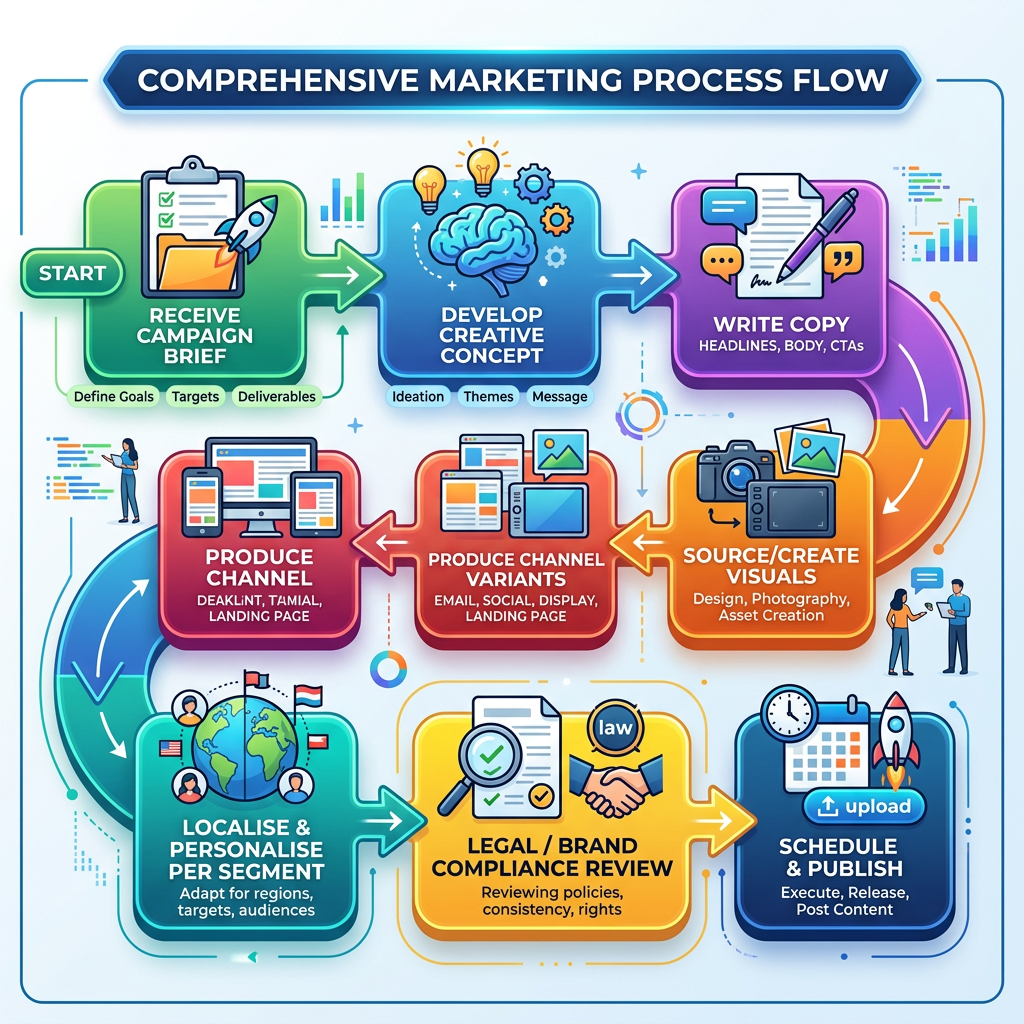
Now we will walk through each steps depicted in our analysis framework and apply it on the above marketing process.
Step 1 — Throughput metric.
This process exists to ship campaign-ready, on-brand assets. Throughput = number of approved campaign variants shipped per week(with a quality floor). Cost-per-asset is the secondary metric.
Step 2 — Decompose.
Average time per campaign across the steps:
| Step | Avg. time | % of cycle |
| Brief -> concept | 1 day | 12% |
| Copywriting (all channels) | 3 days | 38% |
| Visual creation | 1.5 days | 19% |
| Channel variants + localisation | 2 days | 25% |
| Compliance review | 0.5 day | 6% |
| Publish | 0 | 0 |
Step 3 — Find the constraint empirically.
Measure where work actually accumulates rather than relying on intuition. In this process, copywriting and content variant production together consume 63% of the total campaign cycle time. Because every campaign must pass through these stages before progressing further, requests begin to accumulate whenever the demand for new content exceeds the team’s capacity to produce it, leaving subsequent stages of the process waiting for content to be completed.
Step 4 — Apply the decision lens across the whole process (not just the constraint)
The instinct at this point is to say “copywriting is the constraint, so drop generative AI on it, done.” That’s half right. Breaking the constraint is priority one ,but a process is a chain, and once you elevate one link, the bottleneck moves. So we walk every step through a richer decision lens, and we do it with one eye permanently on overall throughput.
Let us now do the walk-through. For each step we ask two things:
- What is the nature of the work? and
- Does throughput justify investing here? (Theory of Constraints).
- Receive campaign brief
| Nature of task | Decision Lens | Throughput view |
| Capturing and routing an intake request. A structured intake form that logs the brief, tags it, and routes it to the right pod | Automation | This sits in the 12% “brief-to-concept” bucket and is not the constraint so keep it cheap and boring. No AI required. |
- Develop creative concept
| Nature of task | Decision Lens | Throughput view |
| The strategic “big idea.” This is where two rows collide: it involves generating ideas (Generative AI) and accountability for brand direction (Human expertise). | Human-led, GenAI-assisted. The strategist owns the concept; GenAI accelerates ideation, mood-boards, | Still inside the non-constraint 12% — use GenAI as a brainstorm partner, not a decision-maker. Don’t over-engineer it. |
- Write copy (headlines, body, CTAs)
| Nature of task | Decision Lens | Throughput view |
| Generating language at volume across channels. brand direction (Human expertise). | Gen AI | This is the constraint (38%). This is where the primary investment goes and where the 3–5× uplift is earned. Human moves from author to editor. |
- Visual Creation
| Nature of task | Decision Lens | Throughput view |
| Generating creative assets | Gen AI ( image generation) under human art direction | 19% and adjacent to the constraint — worth investing, but the human art director stays accountable for brand fidelity. |
- Produce channel variants (email, social, display, landing page)
| Nature of task | Decision Lens | Throughput view |
| This is genuinely two kinds of work | Adapting tone and message per channel is Generative AI; resizing, reformatting, and fitting each asset to rigid channel specs is a deterministic, repetitive action → Automation | Part of the 25% variant/localisation bucket- a hybrid of GenAI (message) + automation (format) is the right build. |
- Localise & personalise per segment
| Nature of task | Decision Lens | Throughput view |
| There are three types of task involved in this step | Translating and adapting language > Generative AI. Deciding which segment should see which message > Predictive AI (propensity/segment models). Deciding how to split budget/impressions across segments > Optimisation algorithms. | Completes the 25% bucket. This single step is the clearest proof that “put AI on it” is a meaningless instruction — three different interventions do three different jobs here. |
- Legal / brand compliance review
| Nature of task | Decision Lens | Throughput view |
| Checking content against rules and claims (a classification task) and signing off (an accountability task). | Predictive AI for an automated first-pass compliance/claims classifier that flags risky content. Human expertise for final legal sign-off on the flagged exceptions. | This is the new constraint. Once GenAI multiplies draft volume 5×, all that copy piles up at a 0.5-day manual review. Per Goldratt, you must elevate this immediately. The classifier triages the safe 80% so humans review only the risky 20%. |
- Schedule & publish
| Nature of task | Decision Lens | Throughput view |
| Three tasks within this step | Choosing the optimal send time / slot per channel > Optimisation algorithms. Pushing the assets out via platform APIs > Automation. Coordinating a synchronised launch across email, social, display and web systems > AI Agents (this is a legitimate agent use orchestrating multiple systems toward a goal). | Near-zero cycle time today, so don’t gold-plate it but the agent-coordinated publish is where a real agent earns its place (contrast this with the hype reflex of putting an agent on everything). |
The throughput-first sequencing rule
We could build all of the above. But Theory of Constraints says, not all at once, and not in random order. Invest in strict order of throughput impact:
- Wave 1 : Break the constraint: GenAI on copy, visuals, and variants (steps 3–5). This delivers the headline 3–5× gain.
- Wave 2 : Elevate the new constraint: the compliance classifier (step 7), because that is exactly where the bottleneck jumps once Wave 1 lands.
- Wave 3 : Smooth the flow: optimisation for scheduling and personalisation, agent-based publishing coordination (steps 6, 8).
Spending on Waves 3 before Wave 2 is the “widen the road before the toll booth” mistake you’d just deliver more copy to a jammed review desk.
The result: right tool, right step, right sequence
| # | Process step | Nature of work | Appropriate intelligence | Constraint? | Throughput priority |
| 1 | Receive brief | Deterministic intake | Automation | No | Low — keep cheap |
| 2 | Develop concept | Idea generation + judgement | Human + GenAI assist | No | Low |
| 3 | Write copy | Generating language | Generative AI (human edits) | Yes * | Wave 1 |
| 4 | Source visuals | Generating creative | Generative AI (human art dir.) | Adjacent | Wave 1 |
| 5 | Produce variants | Message = generate; format = deterministic | GenAI + Automation | Adjacent | Wave 1 |
| 6 | Localise & personalise | Language + targeting + allocation | GenAI + Predictive AI + Optimisation | No | Wave 3 |
| 7 | Compliance review | Classify content + accountable sign-off | Predictive AI + Human | Yes (new) * | Wave 2 |
| 8 | Schedule & publish | Timing + push + multi-system coordination | Optimisation + Automation + AI Agent | No | Wave 3 |
Look at the “Appropriate intelligence” column. Across a single marketing process we’ve deployed all six rows of the lens, generative AI, predictive AI, automation, each exactly where its nature of work belongs, and each sequenced by its effect on total throughput.
That is what “the process is sovereign” means in practice. Generative AI turned out to be the star of this process but even here it was one instrument in an orchestra, not the whole band. The leader who walked in saying “let’s put a GenAI agent on our marketing” would have automated the wrong 12%, ignored the compliance bottleneck that actually caps output, and wondered six months later why throughput never moved.
Step 5 — Second-order effects.
If GenAI raises draft output 5×, the queue moves downstream to compliance review. So the redesign isn’t “generate more copy” — it’s “generate drafts and elevate review”: add an automated brand/claims checker, and keep humans reviewing only the exceptions. Elevate the constraint, then immediately manage the new one.
Step 6 — Friction watch.
GenAI copy needs an editor. If a human rewrites every draft from scratch, you’ve added friction, not removed it. The design must be human-edits not human-writes, with brand-tuned prompts and templates so drafts land close to final.
Lesson 1:
When the constraint is language and creative volume, generative AI can genuinely 3–5× throughput. But you must move the human from author to editor, and immediately manage the constraint it pushes downstream.
4.2 Process Analysis 2 : Manufacturing: production-line quality assurance & equipment uptime
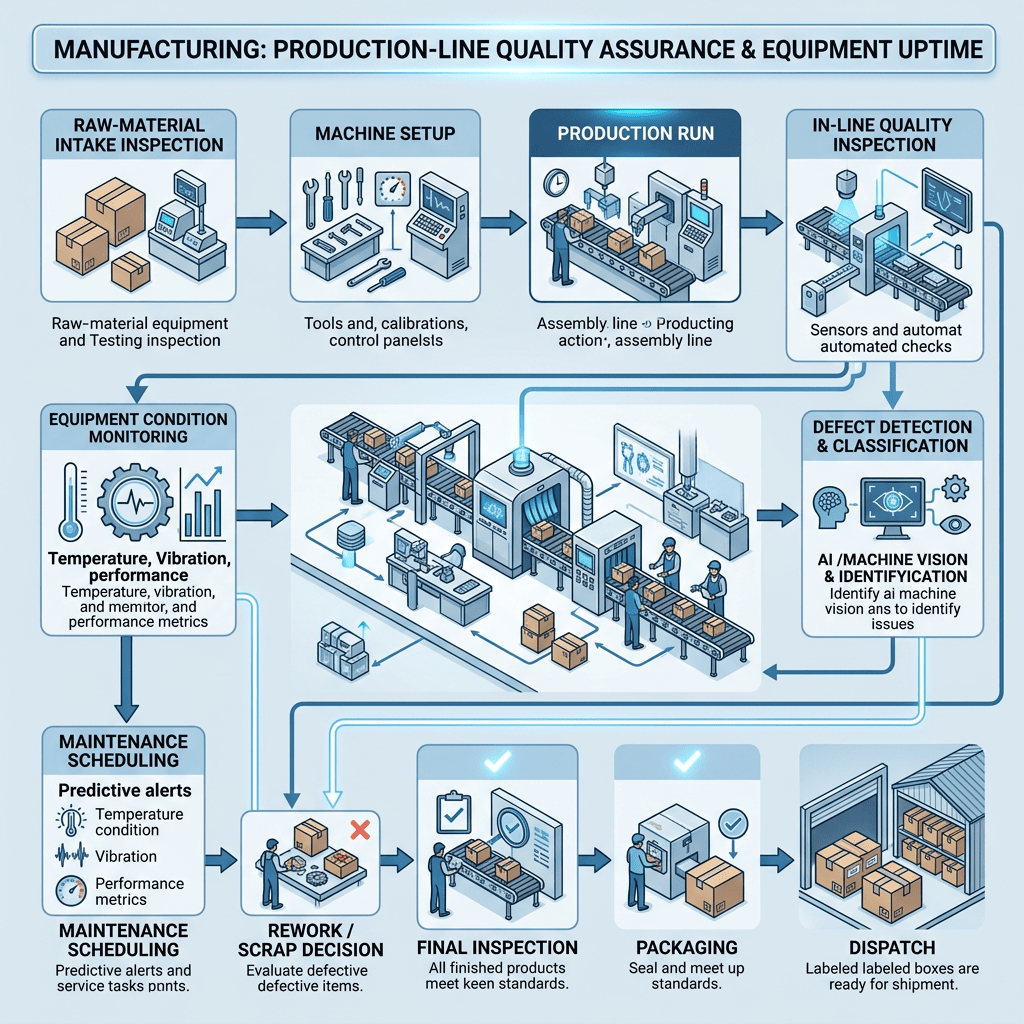
Step 1 — Throughput metric.
The plant exists to do one thing: ship good units. So our throughput metric must capture not just how fast the line runs, but how much sellable, defect-free output it actually produces over the time it was supposed to be running.
The industry-standard measure for exactly this is OEE — Overall Equipment Effectiveness, expressed ultimately as good units per hour. OEE is built from three factors multiplied together:
OEE = Availability × Performance × Quality
Each factor answers a different question about where output is lost:
- Availability — Of the time the line was scheduled to run, how much was it actually running? It captures losses from breakdowns, unplanned stops, and changeovers. (If the line was scheduled for 10 hours but ran for 7.8, Availability = 78%.)
- Performance — When it was running, did it run at its rated speed? It captures losses from minor stops, slow cycles, and idling. (If it ran, but at 91% of design speed, Performance = 91%.)
- Quality — Of the units produced, how many were good the first time? It captures losses from defects, rework, and scrap. (If 87% of units passed without rework, Quality = 87%.)
Step 2 — Decompose OEE.
This plant runs at 62% OEE. On its own, “62%” tells a leader nothing actionable — it’s a single number hiding three very different stories. Decomposing it is what turns a vague “we’re inefficient” into a precise “here is where we bleed.”
0.78 (Availability) × 0.91 (Performance) × 0.87 (Quality) ≈ 0.62 (62% OEE)
Now we can read each factor against a realistic world-class benchmark (roughly 90%+ on each) to see which one is dragging the whole product down:
| OEE component | Actual | World-class benchmark | Gap | What’s actually causing the loss |
|---|---|---|---|---|
| Availability | 78% | ~90% | –12 pts | Unplanned downtime — the line stops when equipment fails without warning |
| Performance | 91% | ~95% | –4 pts | Minor speed losses — small, tolerable |
| Quality | 87% | ~99% | –12 pts | Defect escapes caught late at final inspection, forcing expensive rework |
Each row is one of the three multiplied factors. The Actual column is where the plant is today; the benchmark and gap columns show how far each factor sits below what “good” looks like; the final column names the real-world event that causes that gap.
The table’s message is now unmistakable. Performance (91%) is broadly fine — the machines run at close to rated speed, so chasing speed improvements would be optimising a non-problem. The damage is concentrated in two factors: Availability and Quality, each roughly 12 points below benchmark. And because OEE multiplies, closing those two gaps has an outsized effect — lifting Availability and Quality to benchmark alone would move OEE from 62% to roughly 0.90 × 0.91 × 0.99 ≈ 81%, a near one-third jump in sellable output without a single new machine.
This decomposition is Theory of Constraints in action. The single “62%” number gave us nowhere to aim. Broken into its three drivers, it points a spotlight at exactly two constraints — unplanned downtime and late-caught defects — and tells us, before any investment, that any AI or automation investment in speed(Performance) would be money spent on a non-constraint. That is precisely the “widen the road before the toll booth” mistake this commandment warns against.
These two empirically identified constraints — Availability and Quality — are what we now carry into Step 3 and the decision lens.
Step 3 – Find the constraint empirically.
The OEE decomposition has already narrowed our attention to Availability and Quality. The next step is to verify these findings with operational data rather than assumptions.
The evidence confirms both constraints:
- Availability: Production logs show repeated episodes of unplanned equipment downtime. Critical machines fail unexpectedly, bringing the production line to a halt and reducing the number of productive operating hours.
- Quality: Inspection records reveal that a significant proportion of defects are detected only during final inspection. By this stage, defective products have already consumed materials, machine time, and labour, resulting in costly rework and scrap.
Notice what we are not seeing. There is little evidence that machine speed (Performance) is restricting throughput. The machines are generally capable of operating at their designed speed; the real losses come from machines that are not running at all and from defective products that must be reworked or discarded.
The data therefore validates what the OEE decomposition suggested: the primary process constraints are unplanned downtime and late defect detection. These are the constraints we now take into the decision lens to determine the most appropriate intervention.
Step 4 — Decision lens at the constraints.
Recall the empirically found constraints: Availability (78%) killed by unplanned downtime and Quality (87%) killed by defects caught too late. Now walk every step through the lens, watching throughput.
1 — Raw-material intake inspection
| Nature of tasks | Decision lens | Throughput view |
| Classifying whether incoming material meets spec (vision / measurement pattern-matching) | Predictive AI (vision classification) + Automation (dimensional checks) | Not the headline constraint, but bad inputs cause downstream defects a Wave-3 quality feeder |
2 — Machine setup
| Nature of tasks | Decision lens | Throughput view |
| Configuring the line to a recipe (deterministic) and choosing optimal parameters (speed vs. wear vs. quality trade-off) | Automation (recipe / PLC management) + Optimisation algorithms (optimal parameter sets) | Affects Performance; secondary priority |
3 — Production run
| Nature of tasks | Decision lens | Throughput view |
| Deterministic machine control | Automation (control systems) | Already automated; no AI decision here. Resist the urge to “add AI” to a solved step |
4 — In-line quality inspection
| Nature of tasks | Decision lens | Throughput view |
| Detecting defects from images at line speed — pattern classification | Predictive AI(computer vision) | Quality constraint (* ). Catching defects in-line instead of at final inspection is where the primary quality gain lives |
5 — Defect detection & classification
| Nature of tasks | Decision lens | Throughput view |
| Classifying which defect type (to drive rework vs. scrap) | Predictive AI | Extends the Quality-constraint fix (*) |
6 — Equipment condition monitoring
| Nature of tasks | Decision lens | Throughput view |
| Predicting failure from vibration / temperature / current time-series | Predictive AI | Availability constraint (*). The single highest-value intervention — each avoided stop recovers four hours of full-line output |
7 — Maintenance scheduling
| Nature of tasks | Decision lens | Throughput view |
| Deciding when to service which machine without colliding with production, spares and crew | Optimisation algorithms (the schedule) + AI Agent (coordinating maintenance system, production planner, spare-parts inventory) | Directly elevates Availability alongside Step 6 |
8 — Rework / scrap decision
| Nature of tasks | Decision lens | Throughput view |
| Predict rework success and cost, choose the economically optimal action; edge cases need a person | Predictive AI (rework-yield) + Optimisation(cost-minimising choice) + Human(borderline calls) | The new constraint (*). Once in-line inspection catches 5× more defects, they pile up here . Elevate rework capacity in the same wave. |
9 — Final inspection
| Nature of tasks | Decision lens | Throughput view |
| Last-line classification + accountable sign-off for shipment / compliance | Predictive AI (vision) + Human (release accountability) | Becomes lighter once in-line inspection works, since fewer escapes reach it |
10 — Packaging
| Nature of tasks | Decision lens | Throughput view |
| Repetitive deterministic handling | Automation | Low priority |
11 — Dispatch
| Nature of tasks | Decision lens | Throughput view |
| Deterministic execution + route/load optimisation + coordinating WMS / carrier / ERP | Automation + Optimisation (routing) + AI Agent(system coordination) | Downstream of the plant constraint; smooth later |
So where is Generative AI? Look back, it hasn’t appeared once in the value core. The only honest place for it is at the administrative edges: auto-drafting maintenance work-order summaries, generating shift-handover reports from logs, or a RAG assistant that lets a technician query equipment manuals in plain language. Useful, but peripheral. A leader who walked in demanding “a GenAI agent for the shop floor” would have spent the budget on the 5% that doesn’t move OEE, and left the failing motor unmonitored.
Throughput-first sequencing:
- Wave 1 : Break Availability: predictive maintenance (6) + scheduling optimisation (7).
- Wave 2 : Break Quality and its second-order effect: in-line vision inspection (4–5) plus rework capacity (8) in the same wave.
- Wave 3 : Feed quality upstream: intake inspection (1), setup optimisation (2).
- Wave 4 : Smooth the tail: dispatch routing (11); leave GenAI reporting as a nice-to-have.
Result table:
| # | Process step | Nature of work | Appropriate intelligence | Constraint? | Priority |
| 1 | Raw-material intake | Classify + measure | Predictive AI + Automation | No | Wave 3 |
| 2 | Machine setup | Configure + optimise params | Automation + Optimisation | No | Wave 3 |
| 3 | Production run | Deterministic control | Automation | No | Solved |
| 4 | In-line inspection | Classify defects (vision) | Predictive AI | Yes * | Wave 2 |
| 5 | Defect classification | Classify pattern | Predictive AI | Yes * | Wave 2 |
| 6 | Condition monitoring | Predict failure | Predictive AI | Yes * | Wave 1 |
| 7 | Maintenance scheduling | Optimise + coordinate systems | Optimisation + AI Agent | Yes | Wave 1 |
| 8 | Rework / scrap decision | Predict + optimise + judge edge cases | Predictive AI + Optimisation + Human | Yes (new) * | Wave 2 |
| 9 | Final inspection | Classify + accountable sign-off | Predictive AI + Human | No | Wave 2 |
| 10 | Packaging | Repetitive handling | Automation | No | Low |
| 11 | Dispatch | Execute + route + coordinate | Automation + Optimisation + AI Agent | No | Wave 4 |
The column is dominated by Predictive AI and Optimisation, with automation at the edges and a couple of legitimate coordination agents. Generative AI ,the technology everyone walked in asking for appears nowhere in the value-creating steps.
Step 5 — Second-order effects.
Predictive maintenance lifts Availability; vision inspection lifts Quality. But if you catch far more defects in-line, you may now overload the rework station. Plan rework capacity in parallel, or you’ve simply relocated the bottleneck.
Step 6 — Friction watch.
A vision model that raises false-positive scrap alarms will have operators overriding it within a week — trust dies, and the system is bypassed. Tune for the cost-weighted error the business actually cares about (a missed defect vs. a false alarm), not raw accuracy.
Lesson 2:
When the constraint is prediction or classification from structured/sensor/image data, predictive AI and automation are cheaper, faster, more accurate, and auditable. Generative AI here isn’t just suboptimal — it’s a category error.
4.3 Process Analysis 3 : HR: handling a formal employee grievance
The process, step by step:
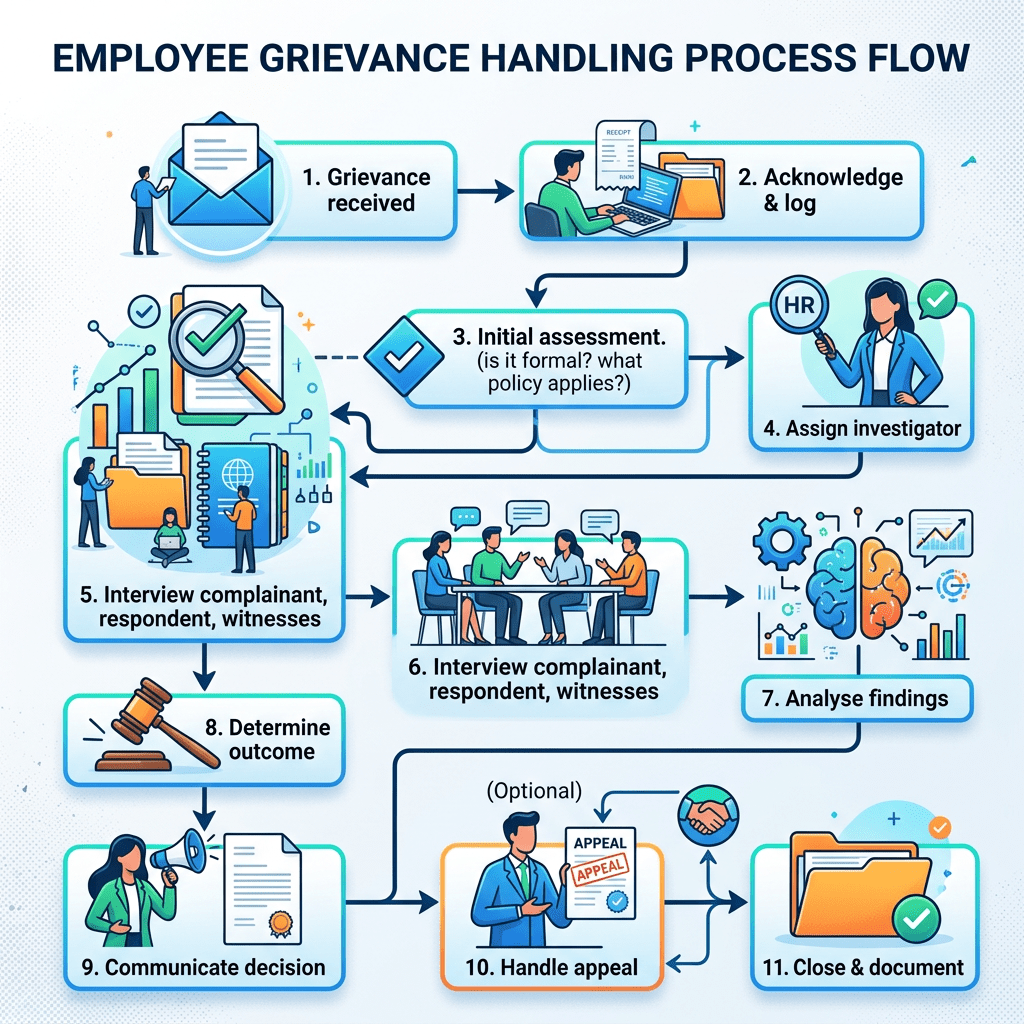
Step 1 — Throughput metric.
Here’s the trap. The obvious metric is time-to-resolution. But this process does not exist to produce resolutions fast . It exists to produce fair, defensible, trusted outcomes. Speed at the cost of fairness is a catastrophic failure, not a win. The right throughput metric is “fair, legally sound resolutions” , with time as a constraint, not the goal.
This is a lesson in itself: not every process should be optimised for raw throughput. Recognising that is part of AI literacy.
Step 2 — Decompose.
Where does the cycle time actually go?
| Step | Time | Nature of work |
| Acknowledge & log | 1 day | Administrative |
| Initial assessment | 2 days | Judgement + policy lookup |
| Scheduling interviews | 5–7 days | Coordination / logistics |
| Interviews | 4 days | Human judgement, empathy |
| Analysis & outcome | 5 days | Human judgement, accountability |
| Documentation | 2 days | Administrative |
Step 3 — Find the constraint empirically.
The time constraint is mundane: interview scheduling (chasing calendars across parties). The value constraints — interviews and analysis — are slow because they should be; they demand human discernment.
Step 4 — Decision lens.
Apply it honestly, step by step:
Remember the two things that make this process different: the throughput metric is fair, legally sound, trusted resolutions (speed is a constraint, not the goal), and the only genuine time bottleneck is mundane – interview scheduling. Walk the lens honestly.
1 — Grievance received
| Nature of tasks | Decision lens | Throughput view |
| Intake of a sensitive report, sometimes delivered verbally and emotionally | Automation (secure digital logging) + Human (empathetic reception when raised in person) | Administrative; keep it frictionless and confidential |
2 — Acknowledge & log
| Nature of tasks | Decision lens | Throughput view |
| Deterministic case creation and acknowledgement | Automation (auto-acknowledge, assign case ID) + narrow GenAI (draft the acknowledgement note, human-approved) | Pure admin automate it, don’t agonise over it |
3 — Initial assessment (formal? which policy?)
| Nature of tasks | Decision lens | Throughput view |
| Classifying the grievance and retrieving the governing policy, then an accountable decision on how to proceed | GenAI (RAG) to surface policy and precedent + Human to decide | AI informs; the human decides. Never let retrieval masquerade as judgement |
4 — Assign investigator
| Nature of tasks | Decision lens | Throughput view |
| Allocating a case to an available, appropriately skilled, conflict-free investigator | Human(conflict-of-interest judgement) | Improving efficiency while maintaining fairness. |
5 — Gather documents & evidence
| Nature of tasks | Decision lens | Throughput view |
| Retrieving and organising records; deciding what is relevant and admissible | Automation (pull from HRIS, email, access logs) + GenAI (organise / summarise) + Human (relevance & admissibility call) | Frees investigator time a safe assist |
6 — Interview complainant, respondent, witnesses
| Nature of tasks | Decision lens | Throughput view |
| Empathy, credibility assessment, reading the room — plus the calendar coordination around it | Human, full stop for the interviews; Automation / Optimisation for the scheduling | The real time constraint (*). Interviews should stay slow and human; the calendar coordination is where 5–7 days evaporate — the one place to elevate throughput aggressively |
7 — Analyse findings
| Nature of tasks | Decision lens | Throughput view |
| Weighing conflicting evidence and credibility | Human judgement, accountable | Slow because it must be. GenAI may help organise evidence, but must not weigh it |
8 — Determine outcome
| Nature of tasks | Decision lens | Throughput view |
| High-stakes, legally accountable adjudication | Human, full stop | Do not optimise. Speed here is not a virtue |
9 — Communicate decision
| Nature of tasks | Decision lens | Throughput view |
| Drafting a legally careful, humane communication, then delivering it with empathy | GenAI (first draft) + Human (owns every word and the delivery) | Assist the drafting; never automate the delivery |
10 — Handle appeal
| Nature of tasks | Decision lens | Throughput view |
| Re-adjudication of the case | Human | Same logic as the core judgement steps |
11 — Close & document
| Nature of tasks | Decision lens | Throughput view |
| Structured case documentation for the record and audit | GenAI (draft summary from verified records) + Human (verify) + Automation (archive / retention) | Admin tail — assist and file |
The hype reflex here is not just wrong, it’s dangerous. “Let an agent triage grievances and recommend outcomes” delegates precisely the judgement, empathy and accountability row — the one row a machine must never own in this context. It imports bias, invents plausible-but-false reasoning, creates legal exposure, and — most destructively — collapses employee trust the instant staff learn a machine judged their complaint. That is a catastrophic second-order effect: fewer people report real issues, problems fester, and litigation risk rises. A faster process nobody trusts has negative net value.
Throughput-first sequencing (here “throughput” means freeing human time for judgement and cutting dead calendar time — never accelerating the judgement itself):
- Wave 1 — Kill the dead time: automate interview scheduling (6), intake/logging (1–2), archiving (11).
- Wave 2 — Assist at the edges: GenAI-RAG for policy lookup (3), document organisation (5), communication and case-summary drafts (9, 11) — every output human-verified.
- Wave 3 — Optimise allocation: investigator assignment (4).
- Never: automate assessment, interviews, analysis, outcome, or appeal (3-decision, 6, 7, 8, 10).
Result table:
| # | Process step | Nature of work | Appropriate intelligence | Constraint? | Priority |
| 1 | Grievance received | Intake (+ empathy if verbal) | Automation + Human | No | Wave 1 |
| 2 | Acknowledge & log | Deterministic case creation | Automation + narrow GenAI | No | Wave 1 |
| 3 | Initial assessment | Retrieve policy → decide | GenAI (RAG) informs + Human decides | No | Wave 2 |
| 4 | Assign investigator | Allocate + conflict check | Human | No | Wave 3 |
| 5 | Gather evidence | Retrieve/organise + relevance call | Automation + GenAI + Human | No | Wave 2 |
| 6 | Interviews | Empathy/judgement (+ scheduling) | Human (scheduling → Automation * ) | Yes * | Wave 1 |
| 7 | Analyse findings | Weigh evidence | Human | No | Never automate |
| 8 | Determine outcome | Accountable adjudication | Human | No | Never automate |
| 9 | Communicate decision | Draft + empathetic delivery | GenAI draft + Human | No | Wave 2 |
| 10 | Handle appeal | Re-adjudication | Human | No | Never automate |
| 11 | Close & document | Structured documentation | GenAI + Human + Automation | No | Wave 2 |
Here the column is dominated by Human expertise, with automation and optimisation confined to the logistical edges and GenAI kept firmly on a leash as a drafting and retrieval assistant — never a decision-maker. And crucially, the biggest throughput win came from automating calendars, not from any AI touching the grievance itself.
Step 5 — Second-order effects.
This is where forcing AI is most destructive. A faster process that employees no longer trust has negative net value: fewer people raise legitimate grievances, issues fester, and litigation risk rises. The second-order damage dwarfs any first-order time saving.
Lesson 3:
Some processes are dominated by a human-judgement constraint that AI cannot and should not relieve. Here the right move is to automate the logistics around the humans (scheduling, documentation) so they spend more time on judgement , never to automate the judgement itself.
5.0 Conclusion
The three processes, side by side
| Marketing content | Manufacturing QA/uptime | HR grievance | |
| Throughput metric | Approved variants/week | Good units/hour (OEE) | Fair, trusted resolutions |
| Dominant intelligence | Generative AI | Predictive AI + Optimisation | Human expertise |
| Automation’s role | Format/publish edges | Control + packaging edges | Scheduling + logging edges |
| Where GenAI belongs | The value core | The reporting edges only | On a tight leash, edges only |
| Biggest throughput lever | Copy generation | Predictive maintenance | Interview scheduling |
| The hype-reflex mistake | Would’ve worked (rare) | Slower, costlier, un-auditable | Destroys trust, legal risk |
One framework. Three honest walk-throughs. Three completely different answers. In every case, the six-row lens did the work — and in only one of the three did generative AI, the technology everyone walks in demanding, turn out to be the right lead instrument.
Now that we have seen three different processes let us now summarise our learning to generate your Commandment 1 checklist.

Before you approve any AI initiative, be able to answer these on one page:
- ☐ What is the single throughput metric this process exists to produce — and is throughput even the right goal, or is it fairness/quality/safety?
- ☐ Have I decomposed that metric across every step to see where time, cost, and errors accumulate?
- ☐ Have I found the constraint empirically — with data on where work queues — rather than guessing?
- ☐ At the constraint, what kind of work is it? (Generate / predict / automate / judge — apply the lens.)
- ☐ What is the second-order effect? Where does the bottleneck move next, and have I planned for it?
- ☐ Where is the friction — review, rework, latency, lost trust — and does it eat my gain?
- ☐ Am I elevating the constraint, or decorating a non-constraint with fashionable technology?
If you can’t answer these, you’re not ready to choose a model, a framework, or an agent. You’re ready to go back and look at your process.
That is Commandment 1 in a single sentence:
“Decompose the process, find the constraint and let the nature of the work at the constraint, not the fashion of the day, choose the tool.
Next in the series — Commandment 2: “Thou Shalt Not Invoke Agents in Vain.” We’ll take the constraints we’ve now learned to find, and confront the most over-prescribed answer of 2025-2026: the AI Agent. When does a problem genuinely need agentic autonomy — and when is a boring, reliable workflow the smarter, cheaper choice?