Part 5 of the series The 10 Commandments of AI in Business: Choosing the right intelligence for the right problem.
1.0 A recap
Commandment 3 was a defence of the humble. We argued that the single well-crafted prompt and the fixed chain quietly solve the majority of real generative AI problems in business, and that with a little engineering discipline, structure, validation, evals, they are both the cheapest and the most trustworthy thing you can put into production. We ended on a warning about a different kind of overreach:
“A great many problems people throw generative AI at aren’t language problems at all. They’re prediction problems, or plain automation.”
So here we are.
Commandments 2 and 3 lived entirely inside the generative world. This commandment steps outside that world and asks the prior question the whole industry keeps skipping:
Should this be generative AI at all? Should it be AI at all?
Because there is an even more unfashionable set of tools than the humble prompt. They are the elders: machine learning, statistical forecasting, rules engines and robotic process automation (RPA). They are decades old. They are boring. And they are frequently more accurate, cheaper, faster, and auditable than the shiny generative thing a team is about to build on top of them. This commandment is a plea not to disown them merely because they no longer trend on LinkedIn.
1.1 The generative costume
Here is the pattern that costs organisations dearly right now. A real, well-understood problem, the kind with decades of proven technique behind it, arrives on someone’s desk. And because “AI” now means “generative AI” in the popular imagination, the team reaches for a large language model, or worse, an autonomous agent, to solve it.
Consider the now familiar story. A retailer decides to “use AI to improve demand forecasting.” A team spends four months and a substantial token bill building a “forecasting agent”, an LLM that ingests sales data, reasons about seasonality in natural language, and produces a forecast for each product. It demos beautifully: you can ask it why it predicted what it did, and it answers in fluent prose. But in production it is slow, expensive per forecast, inconsistent from run to run, and its accuracy on the SKUs that actually matter is mediocre. Worse, its forecasts don’t reconcile: the numbers it generates for individual products don’t add up to the numbers it generates for the category or the region.
Meanwhile, the problem it was built to solve has a mature, well-understood answer: hierarchical time-series forecasting, a discipline with decades of rigour behind it. A proper hierarchical model forecasts at every level, SKU, category, region, national, and mathematically reconciles them so the parts always sum to the whole. It runs in seconds across the entire catalogue, costs a fraction of a penny per forecast, produces the same answer every time, and is more accurate on exactly the items that drive the business.
They built a fashionable forecasting agent for a problem that time-series statisticians solved long ago. And the tragedy is that the agent almost worked, which is precisely what makes this mistake so expensive: the demo was fluent and impressive enough to get funded, and the failure, the cost, the inconsistency, the forecasts that wouldn’t add up, only showed up at production scale.
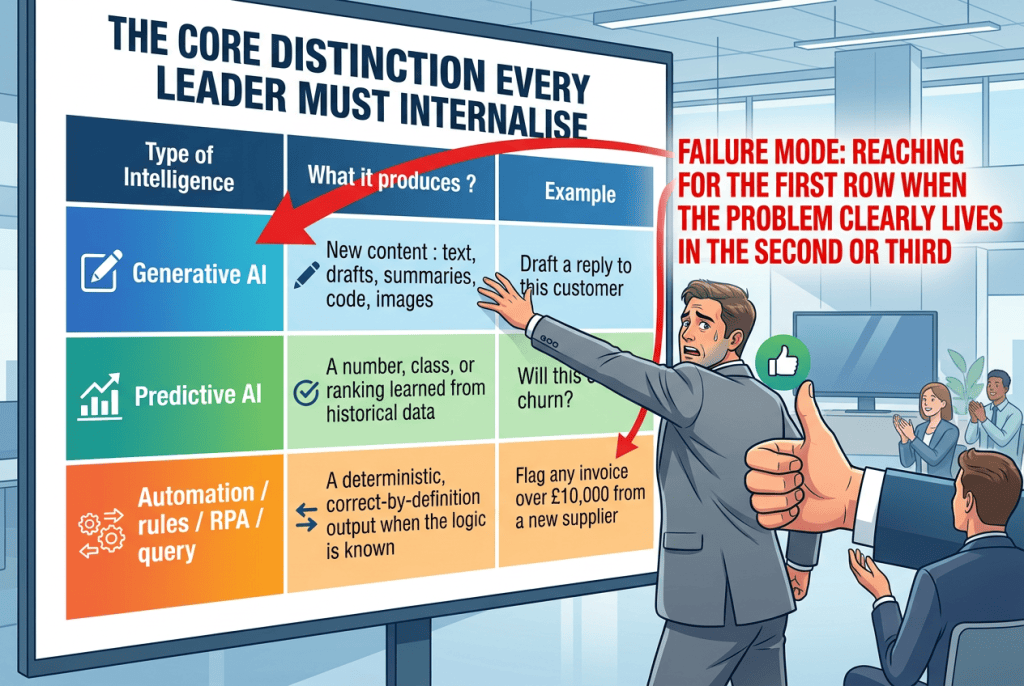
| Type of intelligence | What it produces ? | Example |
| Generative AI | New content : text, drafts, summaries, code, images | Draft a reply to this customer |
| Predictive AI | A number, class, or ranking learned from historical data | Will this customer churn? |
| Automation / rules / RPA / query | A deterministic output when the logic is known | Flag any invoice over £10,000 from a new supplier |
The failure mode of the era is reaching for the first row when the problem clearly lives in the second or third.
1.2 Recognising a predictive problem in disguise
Commandment 3 equips business leaders with a structured framework of patterns to instantly spot and define predictive opportunities. If the desired output is a score, a category, a forecast, or a ranking, the problem is almost certainly predictive, not generative.
Let us learn to recognise this family and you will spot the “let’s build a GenAI system for it” hype immediately:
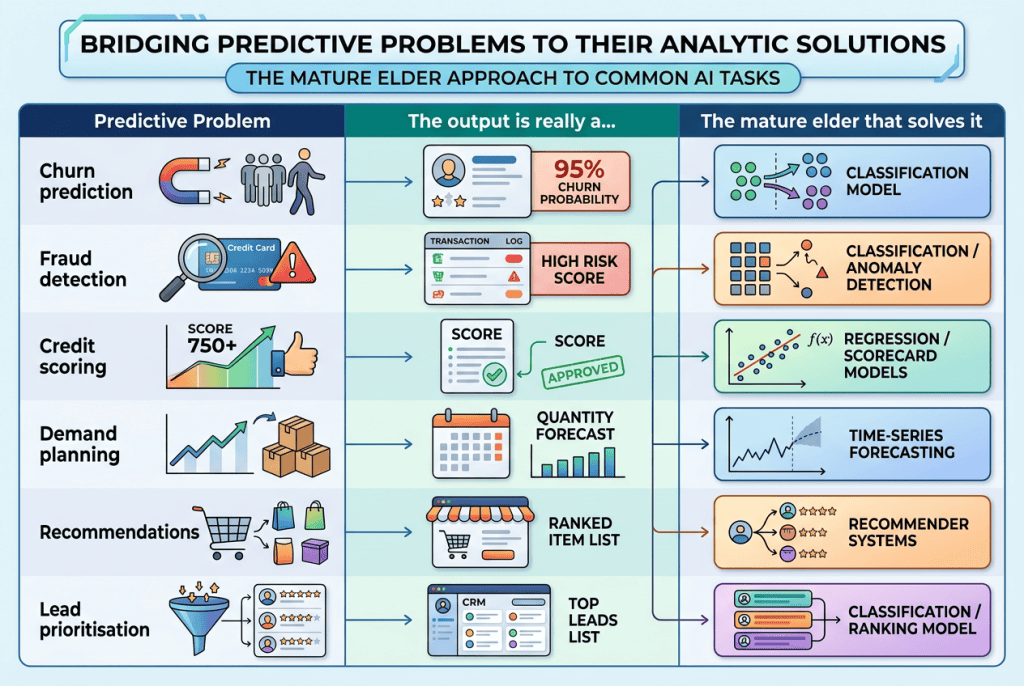
None of these produce new content. They produce a number or a class from patterns in data you already have. That is not the job, a language model was built for.Asking it to do that job means paying more for a less accurate, less explainable answer.
The legitimate exception: a generative wrapper around a predictive core
So far this reads as “keep generative AI away from predictive problems.” That’s too blunt, and it misses one of the most genuinely useful ways the two combine. There is a legitimate and increasingly common role for generative AI here, and it’s worth understanding precisely, because it’s also easy to overdo.
The pattern is this: the predictive model still makes the decision; a generative layer sits on top of it purely as an interface. The churn model still produces the score. The forecasting model still produces the numbers. But instead of that output landing in a dashboard nobody opens, a generative, sometimes agentic, wrapper lets a human converse with it:
- “Which of my accounts are most at risk this month, and why?”
- “What happens to the regional forecast if I run a 10% promotion in March?”
- “Show me the three biggest drivers behind this customer’s fraud score.”
The predictive model computes; the generative layer translates that computation into natural language, fields follow-up questions, and, in the agentic version, orchestrates the calls (fetch the score, retrieve the drivers, run the what-if scenario). This is how generative AI is honestly incorporated into the predictive fold, not as a replacement for the model, but as a conversational skin over it. Note that the wrapper is the communication layer, dressed up as a chat interface.
1.4 But does every predictive problem need one?
This is the discipline that stops the pattern becoming another force-fit. A generative wrapper is an interface, and interfaces cost money and add moving parts. The question is not “can we build a chat interface for this?”, it’s “does this use case actually warrant one?”
Most predictive systems don’t. A fraud model scoring millions of transactions per second needs no conversation, it needs a threshold and an automated action. A demand forecast that feeds directly into an automated replenishment system has no human in the loop to talk to. Bolting a chat interface onto these adds cost and fragility for an audience that doesn’t exist.
A generative or agentic wrapper earns its place only when a human genuinely needs to interrogate, explore, or act on the prediction in a flexible, unscripted way. Some use cases where it is warranted:
- A relationship manager working a churn list. They don’t want a raw score; they want to ask “why is this account at risk, and what’s worked for similar accounts before?” and then have a draft outreach written for them. The exploration is open-ended, so a conversational layer adds real value.
- A planner running what-if scenarios on a forecast. The value is in the dialogue, “what if the promotion slips two weeks?”, “what if the supplier is late?”, which a fixed dashboard can’t anticipate but a generative interface over the model can.
- An analyst investigating a flagged fraud case. A human is already in the loop for high-value flags; letting them ask the model to summarise the drivers and pull related transactions in natural language speeds a genuinely human, judgement-heavy task.
The common thread: a wrapper is justified when there’s a human decision-maker doing open-ended, exploratory work on top of the prediction. Where the prediction feeds an automated action at scale, skip the wrapper entirely, it’s cost without a customer.
So the rule extends cleanly: the predictive elder owns the decision, always. Generative AI may serve as its interface, but only when a human genuinely needs to converse with the answer, and never as the thing computing it.
1.3 When the right amount of AI is none
There is a rung below predictive AI, and it is the most overlooked of all. Sometimes the correct answer is no model whatsoever:
- A rule, when the logic is known and stable. “Route invoices over £10,000 from new suppliers to manual approval” does not require intelligence. It requires an
ifstatement. - RPA, when the task is repetitive, structured, and rule-bound — moving data between two systems, reconciling fields, filling forms. No model, no hallucination risk, fully deterministic.
- A database query, when the “insight” someone is asking an AI to generate is really just an aggregation. “Which region underperformed last quarter?” is a
GROUP BY, not a neural network.
The mindset shift, in the spirit of Commandment 3’s “what’s the simplest thing that reliably works?”: before reaching for any model, ask whether the logic is actually knowable and fixed. If it is, a rule beats a prediction, and a prediction beats a generation, on cost, speed, and trust every single time.
2.0 Three business processes, and where the elders belong
Let’s honour the recurring principle of this series. Look at the actual process, step by step, and place the tool where the nature of the work belongs. In each case below, watch a recurring pattern emerge: the predictive or deterministic elder owns the decision; generative AI, if it appears at all, is confined to the language wrapped around that decision.
Example A: Customer retention (the churn trap)
The seductive framing: “Let’s use AI to understand our customers and reduce churn.”
The process:
Collect customer signals >> Identify who is at risk >> Understand why >> Reach out to save them
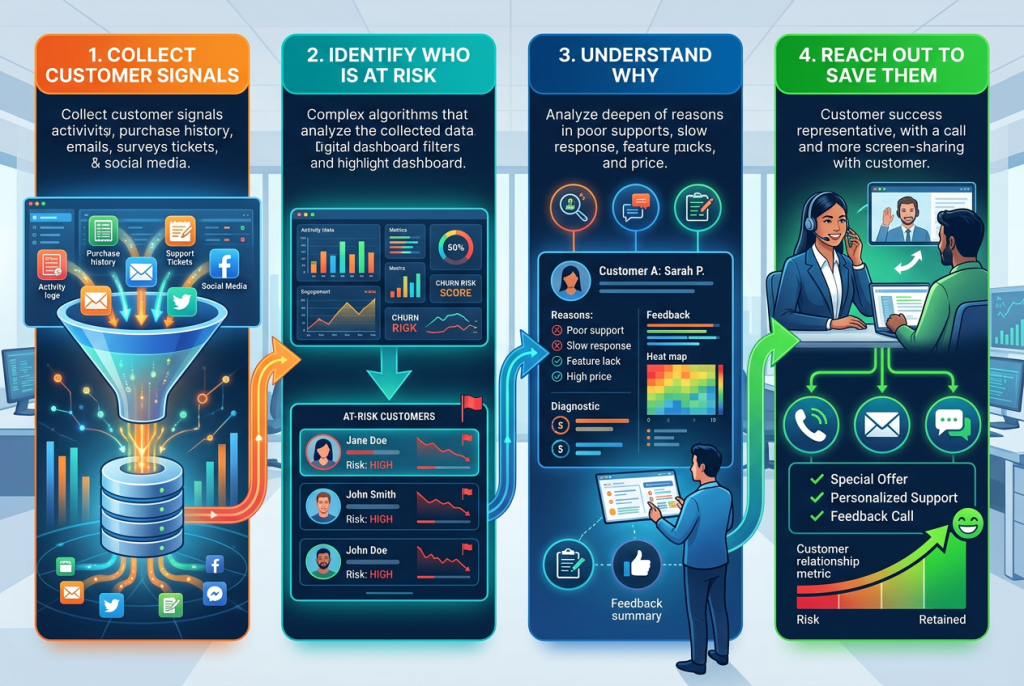
The instinct is to build “a GenAI churn assistant.” But look at the actual work:
| Step | Nature of the task | Correct tool |
| 1. Score each account’s churn risk | Prediction from historical data | Classification model (the elder) |
| 2. Explain the driver per account | Feature importance | Model output, fully explainable |
| 3. Prioritise the outreach list | Ranking | Sort the scores |
| 4. Draft personalised outreach | New content | Generative AI (the youngster) |
Only the last step is a language problem. Steps 1–3 are a textbook supervised-learning job, more accurate, near-free per prediction, and defensible to anyone who asks “why was this customer flagged?” Once the model decides who and why, a humble drafting workflow (Commandment 3) handles the words. The elder makes the decision; the youngster writes the email. Put GenAI in charge of the prediction itself and you get a system that is slower, pricier, less accurate, and unable to explain itself.
Example B: Accounts payable (the automation trap)
The seductive framing: “An AI agent that manages our invoices end to end.”
The process:
Receive invoice >> Read it >> Match to purchase order >> Validate totals >> Route for approval >> Pay
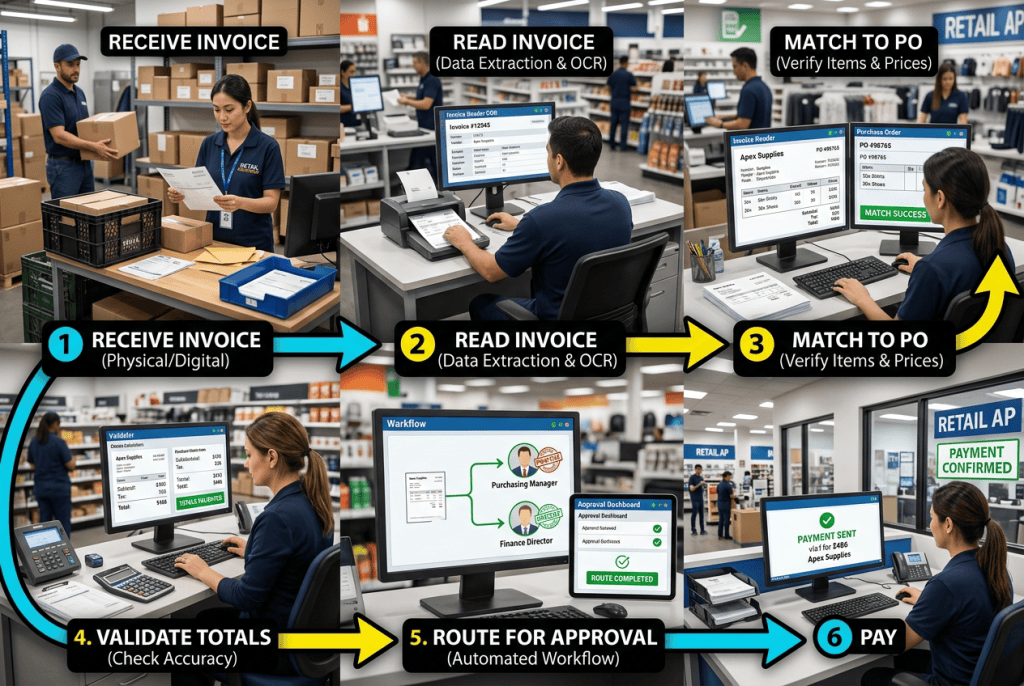
| Step | Nature of the task | Correct tool |
| 1. Read fields from a structured invoice | Deterministic parsing | Template / OCR |
| 2. Read fields from an unstructured supplier email | Extraction | Generative AI (narrow role, per Commandment 3) |
| 3. Match invoice to purchase order | Deterministic lookup | Rules + query |
| 4. Validate totals, tax, dates | Arithmetic and rules | Rules engine |
| 5. Route for approval | Deterministic routing | RPA / workflow rule |
Roughly 90% of this process is deterministic. Matching an invoice to a purchase order is not an act of intelligence, it is a join between two tables. Validating that line items sum to the total is arithmetic. Routing based on amount is a rule. There is exactly one sliver where generative AI earns its place: reading the occasional messy, unstructured supplier email and extracting fields from it, and even that hands its output straight into the deterministic pipeline for validation. Build an “agent” for this and you have introduced hallucination risk and unpredictability into a process whose entire value is that it is auditable and correct by construction.
Example C: Demand planning (the forecasting trap)
The seductive framing: “Let’s ask the LLM how much stock we’ll need next quarter.”
The process:
Gather sales history >> Account for seasonality & trend >> Forecast demand >> Brief the regional managers
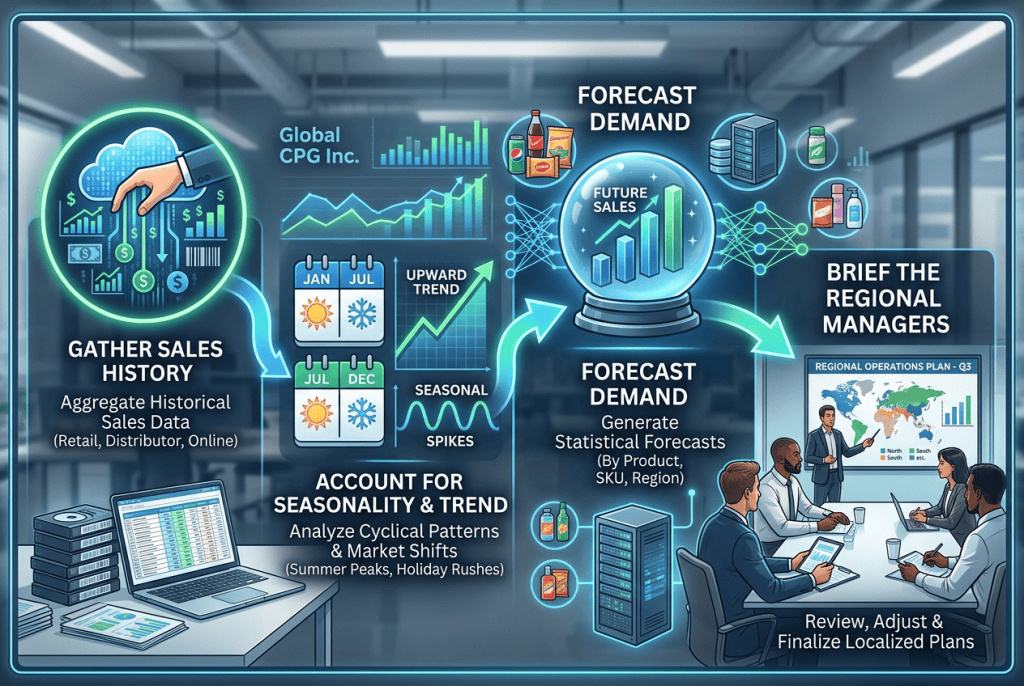
| Step | Nature of the task | Correct tool |
| 1. Forecast demand per SKU per region | Time-series prediction | Statistical / ML forecasting (the elder) |
| 2. Adjust for known events (promotions, holidays) | Rules + features | Model features |
| 3. Turn the forecast into a readable narrative brief | New content | Generative AI (the youngster) |
Time-series forecasting is a discipline with decades of rigour behind it. A proper forecasting model is more accurate, cheaper, and far more defensible than a language model’s plausible-sounding guess about a number it has no basis to know. Asking an LLM “how much stock will we need?” is asking a system with no grounding in your sales data to invent a figure. The generative sliver, again, is purely communication: once the model has produced the forecast, GenAI can turn a table of numbers into a clear narrative brief for each regional manager. It communicates the answer. It does not compute it.
The recurring pattern across all three: predictive AI and automation do the decision; generative AI does the language around the decision. Force-fitting GenAI onto the decision itself is where accuracy, money, and auditability go for a toss.
2.1 The advantages the elders still hold
This is not nostalgia. The older techniques retain concrete, measurable advantages for the problems they own:
| Dimension | Predictive AI / Automation | Generative AI |
| Accuracy on structured problems | High and measurable | Often lower, harder to pin down |
| Cost per decision | Fractions of a penny | Meaningfully higher (tokens) |
| Speed / latency | Milliseconds | Seconds |
| Explainability | Feature weights, clear logic | Opaque reasoning |
| Auditability | Fully traceable | Difficult to defend to a regulator |
| Consistency | Deterministic or stable | Probabilistic, can drift |
For a regulated decision, credit, fraud, anything a customer can appeal or an auditor can challenge, that explainability and auditability column is not a nice-to-have. It is often a legal requirement. A generative system that cannot cleanly answer “why did you decide this?” is not merely inferior here; it may be unusable.
2.2 A field guide to spotting a generative force-fit
Mirroring Commandment 3’s warning signs, here are the patterns that a team has dressed a predictive or deterministic problem in a generative costume. If you spot two or more of these in a proposal, stop and reconsider the tool:
- The output should be a number or a category, but you’re generating a paragraph to arrive at it.
- You have an eval set (Commandment 3) and accuracy has plateaued well below what a simple model reportedly achieves on the same task.
- The unit economics only work at demo scale. The cost per transaction is fine for ten examples and alarming at ten million (a direct foreshadow of Commandment 5).
- An auditor or regulator would ask “why did the system decide this?” and you have no clean, defensible answer.
- The task never changes, yet you’ve built something probabilistic to do it. Fixed logic deserves deterministic tools.
- You have years of clean, labelled historical data sitting unused while an LLM guesses at a problem that data could answer directly.
3.0 The decision lens: which elder (or youngster) does this job need?
When a GenAI proposal lands on your desk, run it through this before approving anything:
| Ask this | If the answer points here… | Then reach for… |
| What is the output : new content, or a number/class/ranking? | A score, class, forecast, or ranking | Predictive AI, not generative |
| Is the logic known and stable, or must it be learned from data? | Known and stable | Rules / RPA / a query — no model at all |
| Do we have labelled historical data for this? | Yes, plenty | Predictive AI is likely viable and superior |
| Must the decision be explained or audited? | Yes | The elders have a decisive edge |
| Is there a genuine language task hidden in the process? | Yes — a draft, summary, or extraction | Generative AI, confined to that step only |
Rule of thumb: Before anyone builds a generative system, prove the problem is genuinely generative. Name the output first. If it’s a score, a class, a forecast, or a ranking, you have a predictive problem, and the unfashionable elder will very likely be more accurate, cheaper, faster, and more defensible.
3.1 The business leader’s checklist
The next time a team pitches an “AI” build, ask:
- ☐ “What exactly is the output, a piece of new content, or a number/category/ranking?” This one question sorts generative from predictive faster than anything else.
- ☐ “Did anyone check whether a simple rule, an RPA bot, or a database query already solves this?” Make no-model the default the model must beat.
- ☐ “Are we paying generative prices for a predictive result?” Tie it to the unit economics, not the demo.
- ☐ “Can we explain and audit this decision if a customer or regulator challenges it?” If not, an opaque generative model may be a liability, not an asset.
- ☐ “Have we confined GenAI to the language layer, and left the decision to a proven technique?” The elder decides; the youngster communicates.
- ☐ “Are we choosing generative AI because it’s right for this problem, or because it’s fashionable?” Be honest about which one is driving the design.
If the honest answers are “the output is a churn score, we have five years of labelled data, a classification model does it for a fraction of a penny with full explainability, and GenAI only drafts the outreach email once the model has flagged the account”. These are use cases where you’ve honoured your elders. Ship the predictive model for the decision, use the humble workflow for the words, and put the fashionable option back on the shelf until a problem actually needs it.
4.0 Conclusion
There is a quiet prejudice in every organisation right now, and it is the mirror of the one we named in Commandment 3. There, complexity was mistaken for competence. Here, novelty is mistaken for capability. Generative AI is new and exciting, so it gets reached for reflexively, while the techniques that would actually solve the problem, forecasting, classification, rules, RPA, are dismissed as old-fashioned plumbing.
But the age of a technique tells you nothing about its fitness for the job. A logistic regression from the 1950s will out-predict a state-of-the-art language model on a churn problem, for a fraction of the cost, with an explanation attached. A rules engine will process invoices without ever inventing a number. These tools are not the embarrassing past we’ve moved beyond. For the enormous class of predictive and deterministic problems that make up much of real business, they are still the correct answer.
Honour predictive AI and automation as thy elders. They do more of the real decision-making than anything with a fancier name, and they do it more cheaply, more quickly, and more defensibly than the costume-wearing generative alternative ever will.
Next up: Commandment 5 – “Thou Shalt Not Slay Thy Token Budget.”
We’ve now covered which tool to reach for, the humble workflow (Commandment 3) and the predictive elders (Commandment 4). But even when you’ve correctly chosen generative AI for a genuine language task, you can still bankrupt the project with a heavyweight implementation. In the next post we turn to cost discipline: why grounding and retrieval deliver the result for a fraction of the compute, why bigger models and bloated context are so often needless extravagance, and how to get the right answer without setting fire to your token budget. Commandment 4 kept you from using the wrong tool. Commandment 5 keeps you from using the right tool wastefully.